Men remembered here
The linked biographies identify each man’s connection with this workplace. This is a partial list; the men may have served in different years.
Edwin ABRAHAM
A Hawkesbury College student, born at Taihape in New Zealand. His sister Mrs McTaggart was his next of kin.
Read his storyJohn BURRELL
A labourer and farmer before enlistment, he reached veterinary work after infantry service.
Read his storyJohn Russell DICKSON
A clerk from Warrnambool whose service later took him to a veterinary evacuating station.
Read his storyErnest William Henry REINMUTH
A Tasmanian commercial traveller, husband of Edith Lucy and father of four children.
Read his storyWhat the men did here
Hospital staff received and identified animals, maintained the stables and assisted treatment. Reinmuth’s accident report records the danger of handling horses: on 31 August 1918 he was presenting one for inspection when it pulled away and kicked him in the face. The report describes him as a good horseman and finds no one to blame.
Photographs show the men’s quarters and cookhouse staff, as well as the animal-treatment establishment.
Where it fitted
This hospital formed part of a wider Australian and Imperial system. Abraham’s service papers record a brief posting in June 1917 before his return to the 5th Mobile Veterinary Section. Dickson joined the hospital in December 1917 and moved to the 1st Australian Veterinary Evacuating Station in May 1918.
These are movements of men. They should not be read as evidence that animals always travelled along the same route.
Brief history
The hospital operated at Coquelles near Calais. The Australian War Memorial holds its diary as AWM4 27/24, covering April 1917 to March 1919. This is the catalogue’s diary coverage, not proof of exact formation and disbandment dates.
Historical material
The photograph below shows the hospital cookhouse staff after the Armistice.
Men’s quarters and hospital entrance, 30 March 1919, AWM E04433 provide another view of the camp. The hospital diary, AWM4 27/24, records its daily work.
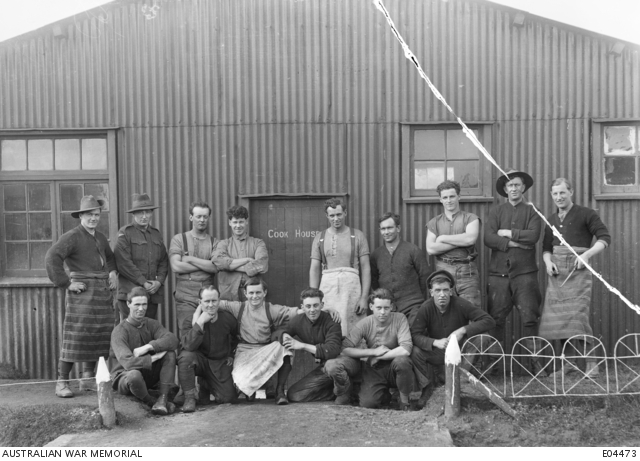
Calais, 31 March 1919. Unidentified Australian Veterinary Hospital cookhouse staff. This photograph was taken after the four men commemorated above had died; none is identified as a man in this picture. Australian War Memorial, E04473, copyright expired. Select the photograph to inspect the full image.
Sources and further reading
- Supplied Australian service-paper reviews, September 2026, retained with the individual profiles.
- Australian War Memorial, John Russell Dickson’s Last Post account.
- AWM diary and photograph catalogue entries linked above. Photograph captions identify the setting, not the unnamed soldiers.