Men remembered here
The linked biographies identify each man’s connection with this workplace. This is a partial list; the men may have served in different years.
Fred ALLEN
A chauffeur from Great Massingham, Norfolk, whose wife Emily was his next of kin.
Read his storyJohn Hartland CADLE
Occupation recorded: Shepherd
Read his storyEdward Frederick CAMPBELL
A private at No. 7 Veterinary Hospital and husband of Ada Campbell.
Read his storyWilliam COCKRAM
Read his storyAlfred Jacob CRIPPS
A London carman who served as a horse keeper. His parents lived at New Southgate.
Read his storyJohn Edward FRANCIS
A Shrewsbury carter who served as a lance corporal and named his mother Mary as next of kin.
Read his storyWilliam KENYON
Occupation recorded: Cart Driver
Read his storyThomas KIRKHAM
A labourer from Somer Wood, Shropshire, who served as a private at the hospital.
Read his storyPatrick Henry MANNING
A former milkman whose sister Mary Hooley was his next of kin.
Read his storyCharles MYCOCK
Occupation recorded: Teacher
Read his storyFurther men recorded with this hospital
What the men did here
Men received and identified animals, cared for patients and prepared drafts for onward treatment. Animals had to be assembled, led or loaded, and handed over at another establishment.
Cripps died in 1915, three years before the diary movements shown below. Manning’s record belongs to a later period.
Where it fitted
During March 1918 No. 7 sent patients to several hospitals for further treatment and care. Nine consignments to No. 8 totalled 354 horses and 47 mules, supported by both sending and receiving diaries. These movements show selective routing for treatment; they do not establish that each hospital treated only one disease.
The large dispatch to No. 6 at Rouen on 31 March appears in No. 7’s record. Its arrival has not yet been fully reconciled with No. 6’s receiving diary.
Receiving hospital: No. 6 at Rouen · Receiving hospital: No. 8
Brief history and command
No. 7 operated at Forges-les-Eaux and sent patients to several hospitals, convalescent establishments and remount depots. During the German offensive in March 1918, movement of animals became an urgent part of keeping the veterinary network working.
The March 1918 diary is signed by Major F. C. O’Rorke, commanding No. 7 Veterinary Hospital.
Historical material
Two dispatches in March 1918
| Date | Destination | Animals |
|---|---|---|
| 11 March | No. 8 Veterinary Hospital — mange cases | 50 horses |
| 31 March | No. 6 Veterinary Hospital, Rouen | 329 horses; 79 mules |
The National Archives, WO 95/4157/5: 11 March, supplied scan page 5; 31 March, scan page 10 (shown below). These dispatch figures have been checked directly against the diary. Graham Hodgkins’s comparisons also support the first movement from No. 8’s receiving record; No. 6’s receiving entry remains to be reconciled.
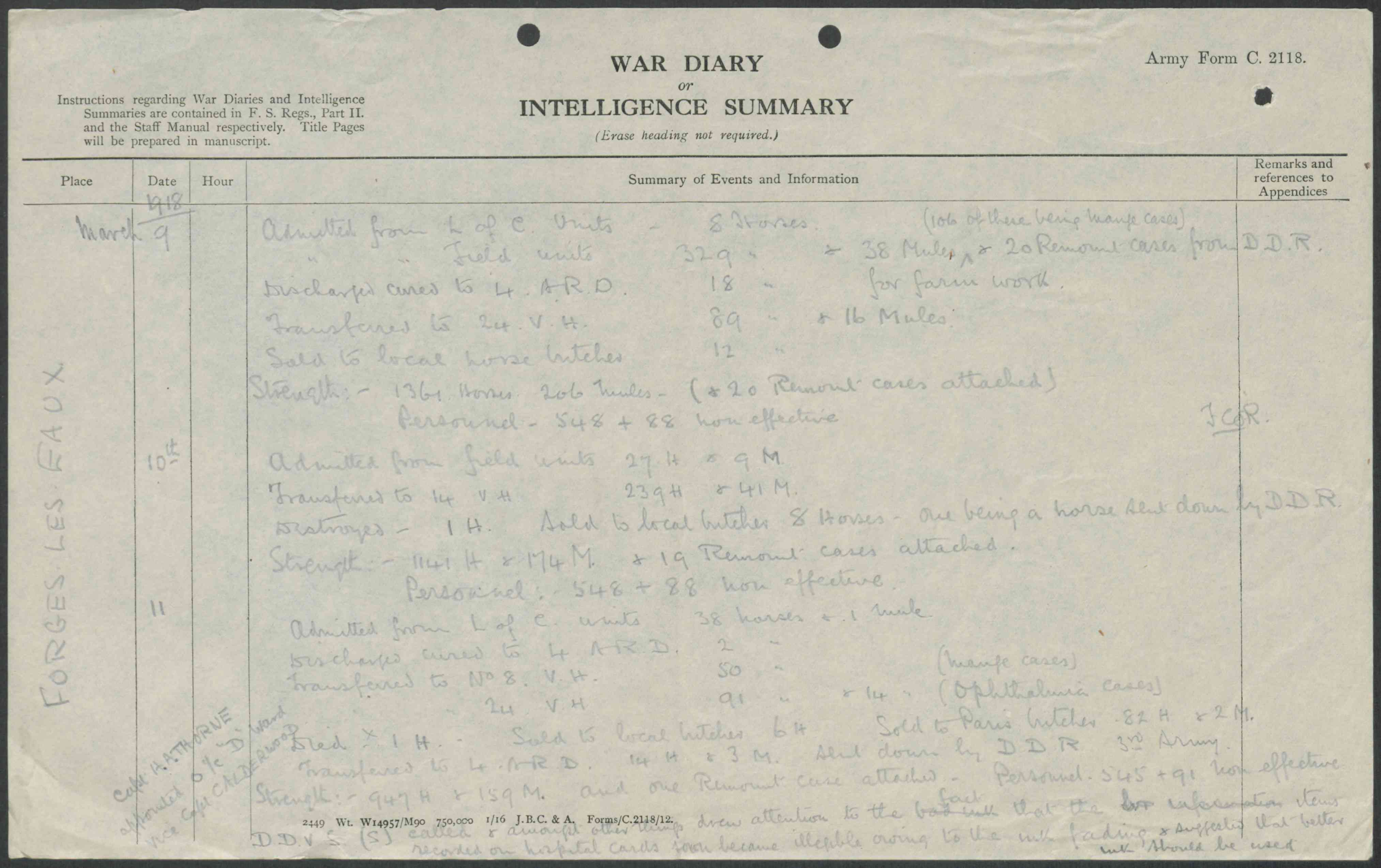
The diary comparisons distinguish an intended dispatch from a movement confirmed at the receiving establishment.
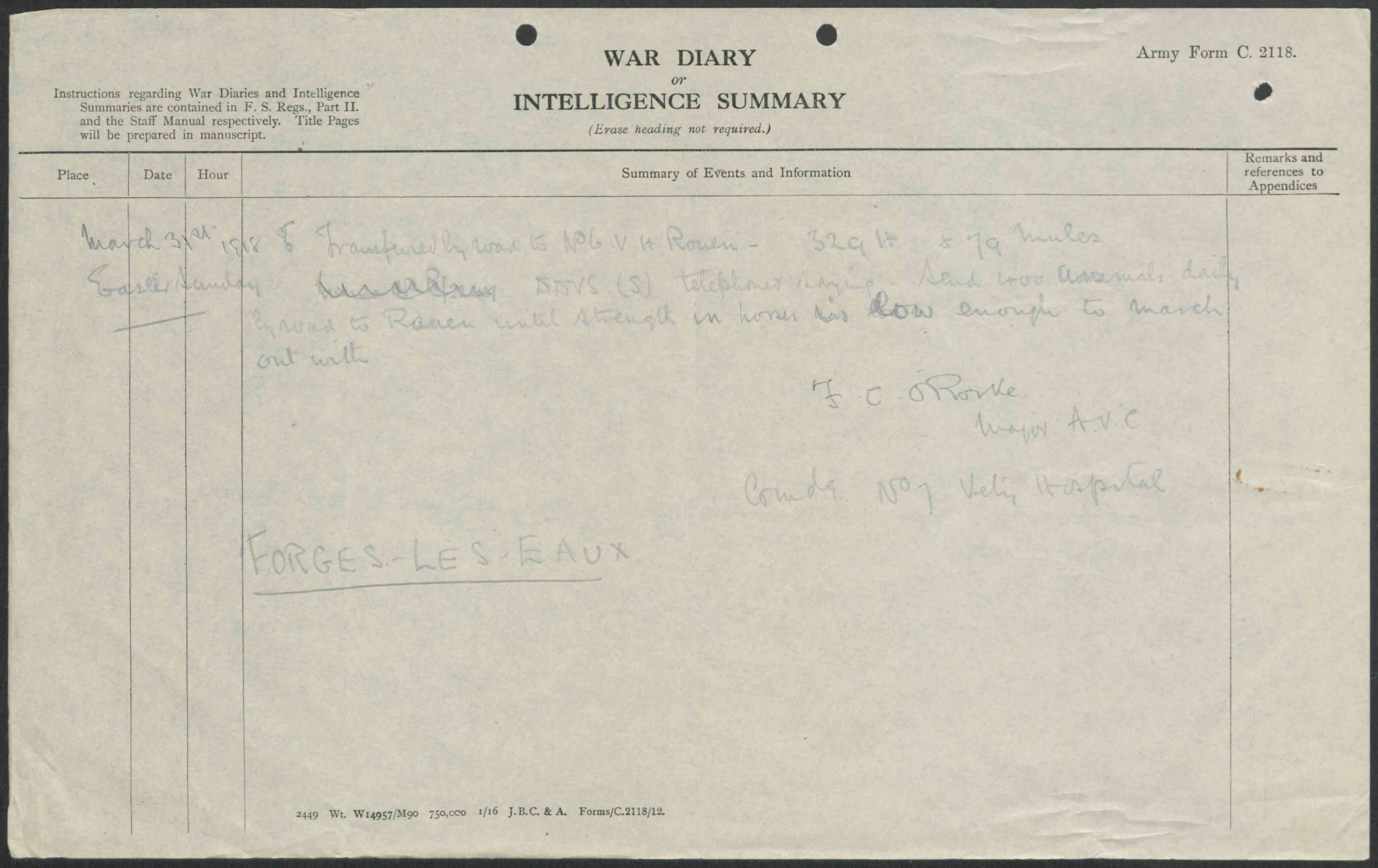
31 March 1918. No. 7’s dispatch entry names No. 6 at Rouen and records 329 horses and 79 mules. The National Archives, WO 95/4157/5, supplied scan page 10. The original faint handwriting is retained. Select the page to read it at full size.
Sources and further reading
- The National Archives, WO 95/4157/5, supplied digital scan: page 1 identifies No. 7, Forges-les-Eaux, March 1918; page 5 records 11 March; page 10 records 31 March and bears O’Rorke’s signature.
- Graham Hodgkins, Sorting the Sick: The Western Front Veterinary-Hospital Network in Operation, research draft, August 2026: March 1918 comparisons with receiving diaries.
- Individual CWGC records and the biographies linked above.